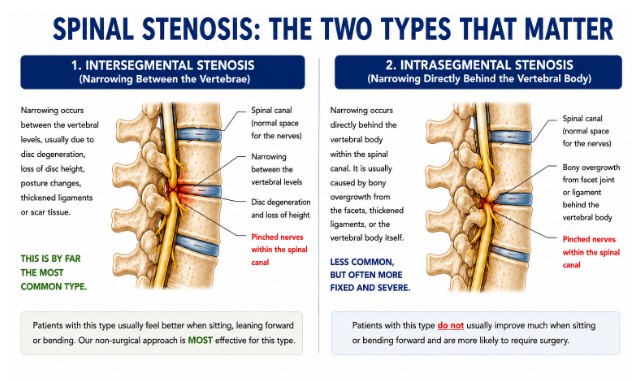
Spinal Stenosis: The Two Types That Matter
Spinal stenosis occurs when the spinal canal narrows and compresses the nerves, causing pain, numbness, tingling, and/or weakness down the arms or legs. Spinal stenosis can occur anywhere in the spine, but it is most common in the low back and neck.
Book OnlineThrough decades of clinical experience and research, I’ve coined the terms Intersegmental Stenosis and Intrasegmental Stenosis. This distinction has been taught in colleges, and postgraduate courses throughout the U.S. Their distinction is of exceptional importance as they are essentially different conditions and need to be treated as such. I am disappointed that at the time of this writing, most doctors still treat these two types of stenosis as if they are the same. The results are poorer outcomes and more unnecessary surgeries.
Intersegmental Spinal Stenosis
(Narrowing Between the Vertebrae)
Surgery is rarely the best answer especially in Intersegmental Spinal Stenosis — especially when the canal is narrowed and the nerves are pinched between the vertebral levels. This is the most common type by far. Characteristic of this type (that responds best to our non-surgical protocol) is the relief that occurs when you sit, or bring your knees to chest. You may even find that you are walking bent forward. This type occurs most often with age and as our spine becomes more compressed (and we often loose some height). You may even notice that your spine becomes more crooked and one shoulder or hip is looking higher than it used to. There are methods (many which we developed and teach) without surgery, that regain much of this space, and allow those damaged nerves to heal, and often the strength and normal sensation to return. We do this everyday in my practice.
Intrasegmental Spinal Stenosis
(Narrowing Within the Spinal Canal)
The nerve compression in this condition more likely comes from a bony spur from the adjacent vertebral body or facet or a prior spinal fracture that’s grown into the nerve. This type is less common, and is often less responsive to our spinal stenosis approach. Often surgery is the best intervention.
Why This Difference Matters
Many patients are told their spinal canal is simply “too small” and that surgery is the only solution. While surgery is sometimes necessary, it is often not the best answer — especially when the narrowing occurs primarily between the vertebral levels, which is the most common type by far.
This commonly develops as we age and the spine gradually compresses. Discs lose height, posture changes, and the normal curves of the spine often become exaggerated, further compressing the nerves leaving the spine.
We have developed non-surgical methods that often restores much of this lost space and reduces or eliminates the pressure on the nerves without the risks or scar tissue formation from the surgery. As we relieve the nerve pressure, the nerves can begin to heal, usually notably relieving in pain, strength, walking tolerance, and normal sensation.
Our Treatment Approach for Intersegmental Stenosis
The treatment approach we’ve developed and taught for Intersegmental Spinal Stenosis is a combination of:
- Specific physical therapeutics to relieve the spinal nerve compression
- Chiropractic and spinal rehabilitation procedures, to mobilize and improve the alignment of the compressed segments
- Non-surgical spinal decompression (a very effective tool to crease more spinal nerve space)
- Strengthening and stabilization programs (to allow your muscles to support the changes we’ve made together)
The goal is to improve spinal alignment, increase separation between the compressed vertebral levels, and restore the strength and elasticity of the shortened, thickened, and scarred soft tissues that help keep the area compressed.
As the spine becomes more mobile and stable, most patients experience significant improvement in pain, walking tolerance, numbness, weakness, and overall function — often avoiding surgery altogether.
However, the results we quote in our research has come from our facility. We have taught this procedure to doctors all over the country but their results have not been studied.
Research and Clinical Results
Our ongoing spinal stenosis research has focused on patients with severe stenosis who often had already failed other forms of treatment including injections, surgery, chiropractic care, and physical therapy.
To See An Abstract Of Our Spinal Stenosis Study go to www.DrRickMorris.com
Frequently Asked Questions
Can spinal stenosis occur outside the low back?
Yes. It can occur anywhere in the spine, but the low back and neck are the most common areas.
Is surgery always necessary?
No. Many patients with Intersegmental Spinal Stenosis improve significantly with specialized non-surgical treatment.
Why do I feel better leaning forward?
Leaning forward temporarily increases the space between the vertebrae, reducing pressure on the nerves within the spinal canal.
Which type responds best to non-surgical treatment?
Intersegmental stenosis — where the narrowing occurs primarily between the vertebrae — is usually the type that responds best to our non-surgical approach.